
On an animal website that publishes breed sheets, care guides, kibble comparisons, and training advice, finding a specific article can quickly feel like a treasure hunt. The sitemap addresses this issue: it lists and organizes the pages of the site so that search engines and visitors can navigate it easily. Understanding how to utilize it changes the way one browses a portal dedicated to animals.
HTML Sitemap and XML Sitemap: Two Distinct Uses on an Animal Website
The two formats are often confused, even though they serve different audiences. The XML sitemap is intended for search engine crawlers. It provides them with a structured list of URLs, sometimes accompanied by the last modified date, to help them discover and index the pages. A human visitor who opens this file encounters raw code, which is not useful for navigation.
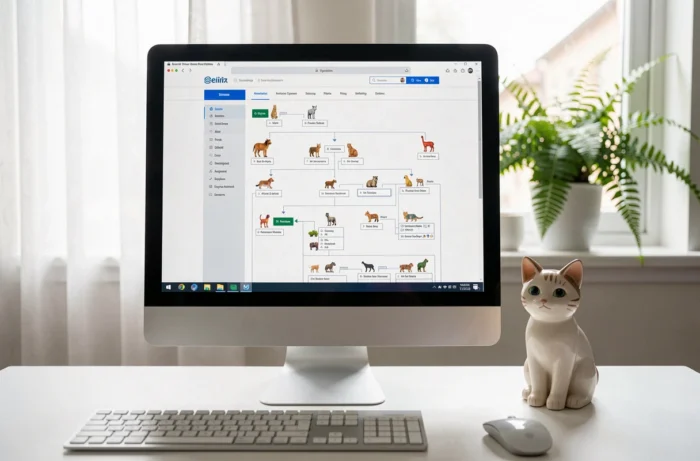
The HTML sitemap, on the other hand, is a page of the site that is readable by anyone. It presents the sections as clickable links, grouped by categories. On an animal-focused site, you typically find sections like “Dogs,” “Cats,” “Small Pets,” “Veterinary Care,” or “Nutrition.” It is this version that serves as a concrete navigation map.
You can check out the sitemap page of Espace Animaux to see what a well-organized site map by animal themes looks like, with distinct categories and direct links to each piece of content.
Navigate by Animal Categories Using the Site Map
Let’s consider a common situation: you’re looking for information on ferret nutrition, but the main menu of the site only offers a generic “Small Pets” entry. You could type keywords into the internal search bar, but it needs to function properly. The HTML sitemap provides a more reliable alternative.

By opening the site map, you can find the category “New Pets,” then the subcategory “Ferret,” and finally the article on nutrition. The sitemap acts like a flat summary that bypasses dropdown menu navigation.
This shortcut is particularly useful in three cases:
- The site covers many species (dogs, cats, rodents, birds, reptiles) and the menus cannot display everything without becoming unreadable.
- You are looking for old content, published several months ago, which the homepage no longer highlights.
- You are browsing on mobile, where nested menus are often cumbersome to expand, and a site map with simple text links is quicker to navigate.
The W3C also recommends providing multiple navigation methods on a site, including a site map, breadcrumbs, and clear titles. For an animal portal that caters to a variety of profiles (beginner owners, breeders, veterinarians), this redundancy in access paths is not a luxury.
XML Sitemap and Indexing: What Search Engines See of Your Animal Site
The XML sitemap does not directly serve human navigation, but it determines which pages will appear in search results. On an animal website, an unindexed article is an invisible article for anyone searching “kitten dewormer” or “minimum cage for parakeet” on Google.
A often overlooked point: the “lastmod” value in the XML file must reflect a real content change. If a dog care guide is updated with new recommendations, the “lastmod” date signals to crawlers that the page deserves a new visit. Bing specifies that this date should not be changed simply because the sitemap file has been regenerated, without any real change on the page.
For a site that regularly publishes breed sheets or seasonal articles (tick protection in spring, winter precautions for horses), keeping an XML sitemap updated enhances the perceived freshness of the site by search engines.
Check That the XML Sitemap Works
You can access the file by adding “/sitemap.xml” to the end of the site’s URL. If the page displays a structured list of URLs, the file exists. To go further, Google Search Console allows you to submit this file and check which URLs have been detected, which are indexed, and which have issues.
An XML sitemap can contain up to 50,000 URLs. Most animal sites do not reach this limit, but portals that combine encyclopedic sheets, forums, and online shops may come close. In this case, the sitemap is segmented into several files linked by an index file.
Accessibility and Sitemap: A Complement to Menus for All Visitors
The HTML sitemap is not just a comfort tool. For people who have difficulties navigating complex menus (cognitive disorders, keyboard navigation, screen readers), a well-structured site map serves as a safety net. The W3C recommends consistent navigation from one page to another, with clearly identifiable links.
On an animal website, this translates to explicit titles in the sitemap. “Cat Dental Care” is more useful than “Article 347.” Each link should describe the content of the target page unambiguously.
A properly tagged HTML sitemap also complements breadcrumbs. If a visitor lands on a “Australian Shepherd” sheet via Google but does not understand how to navigate back to the “Dog Breeds” category, the site map provides them with a stable reference point, accessible from the footer or a link at the bottom of the menu.
The sitemap does not replace good internal linking or a logical structure. On an animal-focused site, it functions as a parallel table of contents: search engines use it to explore content, while visitors use it to find a specific page. Ensuring that the XML file is submitted in Search Console and that a readable HTML version exists on the site is sufficient to cover both needs.