
Trichobacteriosis is a superficial bacterial infection of the hair often confused with a fungal infection. Its historical name, “trichomycosis,” perpetuates this error. Understanding what this condition entails in terms of diagnosis, treatment, and differential diagnosis helps avoid inappropriate management, which can sometimes be burdensome and costly.
Trichobacteriosis and suppurative hidradenitis: an underestimated risk of diagnostic confusion
Among the rarely discussed angles in public content, the confusion between axillary trichobacteriosis and early suppurative hidradenitis deserves particular attention. Both conditions share a common location (the armpits), an unpleasant odor, and a context sometimes associated with excessive sweating.
This superficial resemblance sometimes leads to errors in therapeutic orientation. Recent clinical reviews report that cases of trichobacteriosis are labeled as suppurative hidradenitis, which can result in proposals for biotherapies (anti-TNF, anti-IL-17) or prolonged antibiotic therapies such as clindamycin-rifampicin, which are completely disproportionate for a benign infection.
The distinction relies on a careful clinical examination. In trichobacteriosis, the underlying skin remains healthy, and the whitish or yellowish concretions encase the hair shafts. Suppurative hidradenitis, on the other hand, involves painful nodules, abscesses, and often scars. An examination with a Wood’s lamp may be sufficient to decide: yellow to green fluorescence points towards trichobacteriosis.
Those who wish to delve deeper into the subject will find a treatment for trichobacteriosis on Le Portail de la Santé that details local therapeutic options.

Corynebacterium and hair colonization: mechanism of trichobacteriosis
The term “trichomycosis” suggests a fungal origin, but the responsible agent belongs to the genus Corynebacterium. These bacteria colonize the surface of the hair shafts without penetrating the skin or the hair follicle, which clearly distinguishes trichobacteriosis from deep fungal infections.
Corynebacteria form adherent concretions around the hair. These deposits, visible to the naked eye, can be white, yellow, or sometimes reddish. Their presence is favored by a warm and humid environment.
Factors favoring bacterial colonization
- Excessive sweating (hyperhidrosis), whether constitutional or related to a tropical climate, creates a favorable environment for the proliferation of corynebacteria on the hair shafts
- Insufficient or irregular hygiene of hairy areas (armpits, pubis, chest) allows bacteria to establish themselves permanently
- Wearing tight or synthetic clothing that retains heat and moisture against the skin promotes local maceration
A clinical case published by La Revue du Praticien illustrates this mechanism well: a 25-year-old soldier on a mission in the Central African Republic developed bilateral axillary trichobacteriosis, as the tropical heat and field conditions created an ideal environment for corynebacteria.
Clinical diagnosis of trichobacteriosis: what the doctor observes
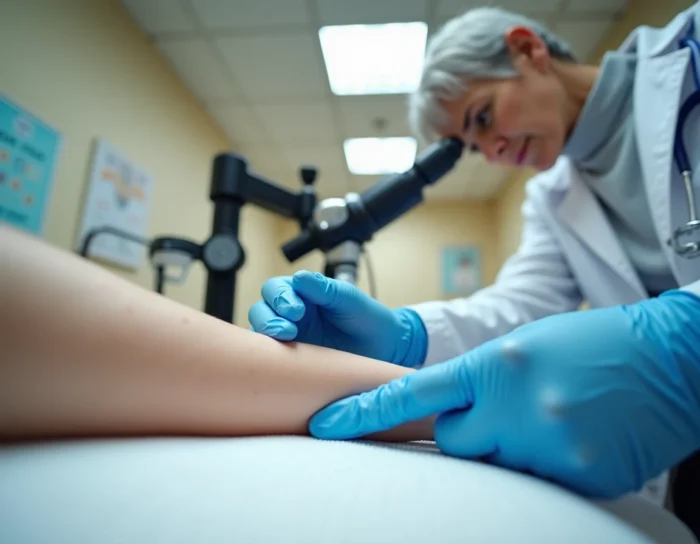
The diagnosis is primarily clinical. The practitioner looks for hairs encased in a granular material, often whitish, in the armpits or pubic region. The underlying skin shows no redness, inflammation, or lesions.
The Wood’s lamp serves as a simple complementary tool. Under ultraviolet light, the bacterial concretions emit a characteristic yellow to green fluorescence, confirming the diagnosis without the need for sampling or bacteriological culture.
| Criterion | Trichobacteriosis | Fungal infection of the hair |
|---|---|---|
| Responsible agent | Corynebacterium (bacteria) | Dermatophytes (fungi) |
| Depth of involvement | Surface of the hair shaft only | Can reach the follicle and skin |
| Underlying skin | Healthy, without inflammation | Often inflammatory, possible scaling |
| Wood’s lamp | Yellow-green fluorescence | Variable depending on the fungal species |
| Severity | Benign, often asymptomatic | Variable, sometimes chronic |
Treatment of trichobacteriosis: shaving and antiseptics as first-line
The treatment relies on two simple actions: shaving the affected hairs and applying a foaming antiseptic. This local approach is sufficient in the vast majority of cases, as trichobacteriosis is a strictly superficial infection.
In addition to shaving and antiseptic cleaning, a local application of antibiotic may be prescribed. The drug treatments mentioned in the literature include triclocarban and imidazole.
Associated bromhidrosis and quality of life
The unpleasant odor associated with trichobacteriosis goes beyond mere cosmetic inconvenience. Corynebacteria produce volatile compounds responsible for bromhidrosis, which can have a real impact on social and professional life.
This dimension is often minimized in clinical descriptions that qualify the condition as “benign.” The impact on quality of life alone justifies active management, even in the absence of pain or medical complications.
- Shaving mechanically eliminates the bacterial reservoir fixed on the hair shafts and immediately reduces odor
- The foaming antiseptic used daily for a few weeks prevents recolonization
- Clothing adjustments (natural fabrics, loose clothing) limit recurrence by reducing maceration
Trichobacteriosis remains a condition that most general practitioners or dermatologists quickly identify when they think of it. The main trap remains the confusion with other fold pathologies, which can lead to unnecessary assessments and treatments. A targeted examination of the hairs and a Wood’s lamp are sufficient to make the diagnosis and initiate effective local treatment within a few days.