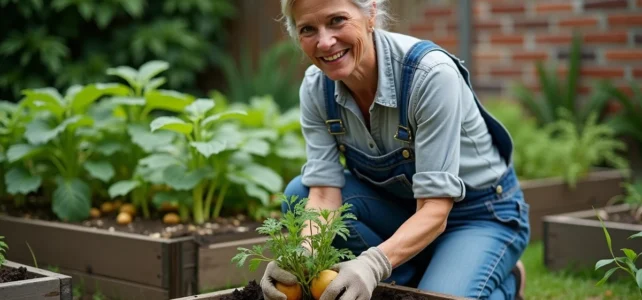
Producing potatoes in quantity without a large vegetable garden requires rethinking how each square meter is used. The classic spaced row cultivation, inherited from open-field market gardening, wastes a considerable portion of the available surface. On a balcony, terrace, or small urban garden, the constraints are different, and so are the solutions.
No-till cultivation: lay, cover, harvest
Most guides recommend digging furrows and hilling the plants throughout the season. This approach works, but it takes up a lot of ground space and requires significant physical effort.
Recent feedback from market gardeners practicing living soil describes a more compact alternative. The principle: lay the tubers directly on the ground, then cover them with a thick mixture of compost and organic matter, topped with a dense mulch. No tilling, no mechanical hilling. The tubers form in the layer of organic matter, making harvesting easier (just pull back the mulch) and improving soil structure for subsequent crops.
Field reports vary on exact yields, but several testimonies indicate that the production per square meter exceeds that of traditional row cultivation. The likely explanation: the absence of pathways between rows allows for closer planting, and the organic layer maintains consistent moisture around the tubers. Finding other gardening tips on Clic Garden can complement this approach with variations suited to each garden configuration.
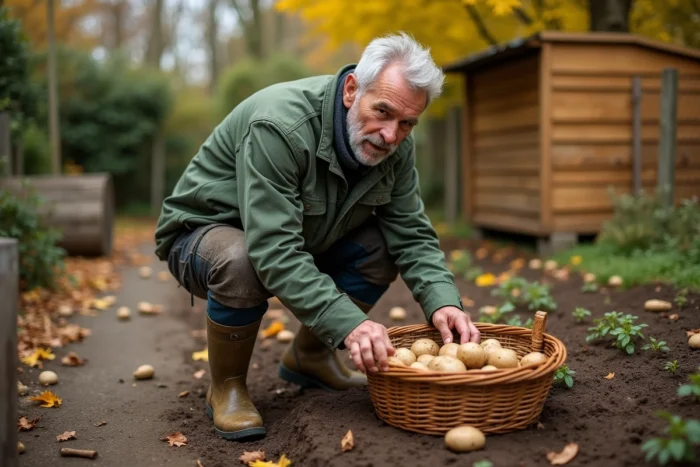
Growing bags and vertical containers for potatoes
When ground space is limited to a few square meters, verticality becomes a lever. Geotextile growing bags, stacked crates, or large deep bins utilize height rather than spread.
The multi-harvest growing bag
A test published in 2024 by L’Ami des Jardins shows that a large growing bag can first produce four lettuces, then a harvest of potatoes described as “surprisingly large.” The principle is simple: utilize the free surface of the bag at the beginning of the season with short-cycle salads, then let the potato plant occupy the entire volume once it takes over.
This double harvest in the same container maximizes yield per unit area without any additional investment. The bag can be placed on a balcony, terrace, or even a corner of a concrete yard.
Stacked crates and tiered cultivation
Stacking crates or wooden frames creates a column for cultivation. A layer of potting soil is placed, tubers are added, another tier is added when the stems exceed, and so on. This system works well for long-stemmed varieties that form tubers at different levels.
There are limits: beyond three or four tiers, light and air circulation become insufficient for the lower tiers. The substrate also dries out faster at height, requiring more frequent watering.
Choosing potato varieties suitable for small spaces
Not all varieties respond the same way to dense or vertical cultivation. The choice of plant directly affects the outcome.
- Early varieties (harvested in less than three months) allow for quick space release for a second crop in the same season, doubling the annual yield per square meter.
- Waxy varieties generally produce more but smaller tubers, which are better suited for limited volume containers.
- Late varieties with strong vegetative growth require more space and soil depth, making them less suitable for bags or towers.
Favoring early or semi-early varieties remains the most consistent recommendation for a compact garden. Quick rotation frees the container for autumn vegetables or a second summer planting.
Soil, mulching, and fertilization in small spaces
In a container or on a small plot, the soil depletes faster than in open ground. The potato is a nutrient-hungry vegetable that draws a lot of nutrients, especially potassium.
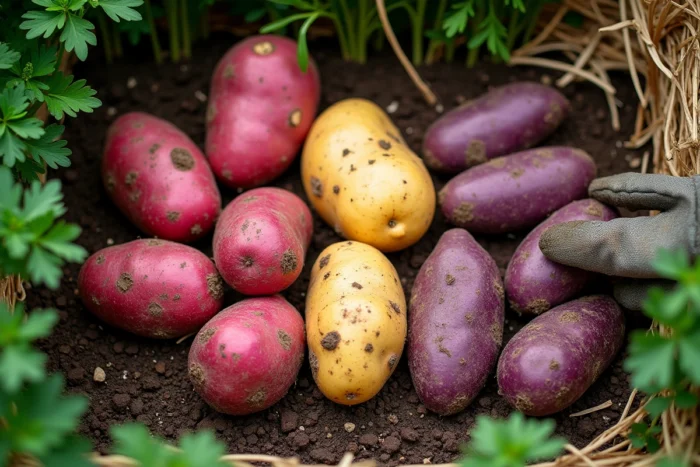
A supply of mature compost before planting forms the basis. During cultivation, organic mulching (straw, hay, dead leaves) plays a triple role: it limits evaporation, maintains a stable temperature around the tubers, and slowly decomposes to nourish the soil.
In small spaces, watering deserves special attention. The substrate in bags and towers dries out much faster than open ground. Water stress during tuberization (when the tubers swell) significantly reduces the harvest. Regular watering without over-saturating, checking moisture a few centimeters deep, makes the difference between a decent harvest and a disappointing one.
Planning plantings to harvest potatoes throughout the season
In a small space, staggering plantings rather than planting everything on the same day allows for spreading production and avoids ending up with a mountain of tubers to store all at once.
- A first planting of early varieties as soon as the soil reaches a sufficient temperature in spring.
- A second planting three to four weeks later with a semi-early variety.
- If the climate allows, a third planting in early summer for an autumn harvest.
Each wave of planting utilizes the space freed by the previous one, effectively cultivating two to three times the same area in a single season. This principle of rapid rotation transforms a small square of garden into a nearly continuous productive surface.
The limit of this approach depends on the climate. In regions where late frosts persist until May, the first planting is delayed, and the third becomes risky. Adapting the schedule to one’s geographical zone remains the most determining variable for maximizing the annual potato harvest on a reduced surface.