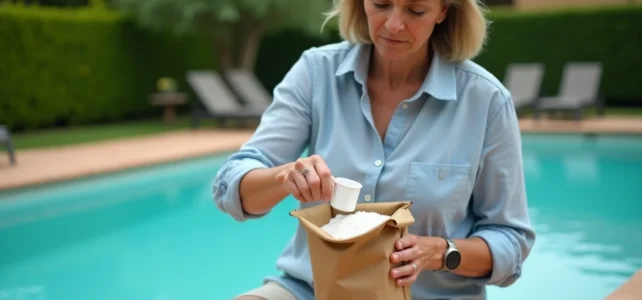
You pour soda percarbonate into your pool to raise a pH that stagnates below 7.0, and two hours later the tester shows the same value. This situation is common because percarbonate does not act on pH in the same way as a dedicated corrector. Understanding what this product actually does in the water helps avoid endless corrections and allows for its proper use at the right time.
Sodium percarbonate and pool chemistry: what really happens in the water
Sodium percarbonate is a compound that, when in contact with water, decomposes into two elements: sodium carbonate and hydrogen peroxide. The former is an alkalizing agent, while the latter is an oxidizing agent. Thus, it creates a hybrid product, halfway between a pH corrector and a cleaner.
It is this dual action that creates confusion. Percarbonate is not designed as a pH regulator in the technical sense of pool treatment. Manufacturers of pool products classify it more as a bleaching and surface cleaning agent. The amount of sodium carbonate it releases can indeed raise the pH, but in a less predictable manner than a pure pH+ product.
In practice, it is used for a quick boost when the pH is slightly low and the water needs simultaneous oxidizing treatment (cloudy water, early signs of greening). For a pH that regularly drops below 7.0, a detailed guide on sodium percarbonate for pool pH helps calibrate its use without choosing the wrong product.
TAC and pH: correct in the right order before touching percarbonate
A common reflex is to pour an alkalizing product as soon as the pH is too low. The problem is that without checking the TAC first, any pH correction remains unstable. TAC (total alkalinity) measures the buffering capacity of the water, meaning its resistance to pH variations.
If the TAC is too low, the pH constantly fluctuates. You correct it, it rises, then it drops again within a few hours. You add more product, and the cycle starts again. This correction loop is the classic trap pointed out by water treatment professionals.
Concrete steps to follow
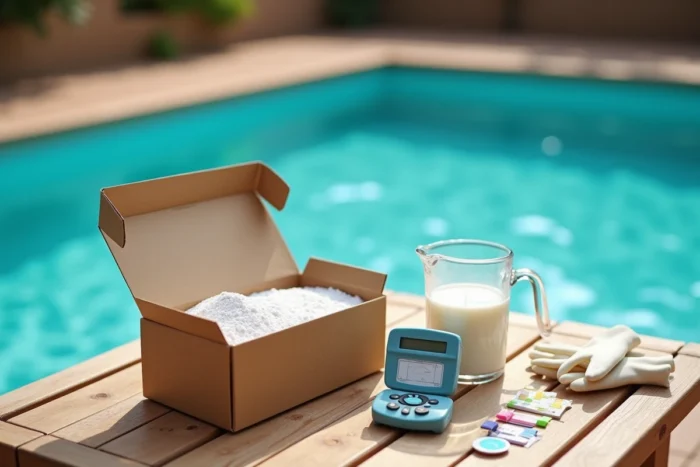
- Measure the TAC with test strips or a photometer. The target range is generally between 80 and 120 ppm for a chlorine-treated pool.
- If the TAC is low, raise it with baking soda (which primarily affects alkalinity) before addressing the pH.
- If the TAC is correct but the pH remains low, use a pH+ product (sodium carbonate) or, occasionally, sodium percarbonate.
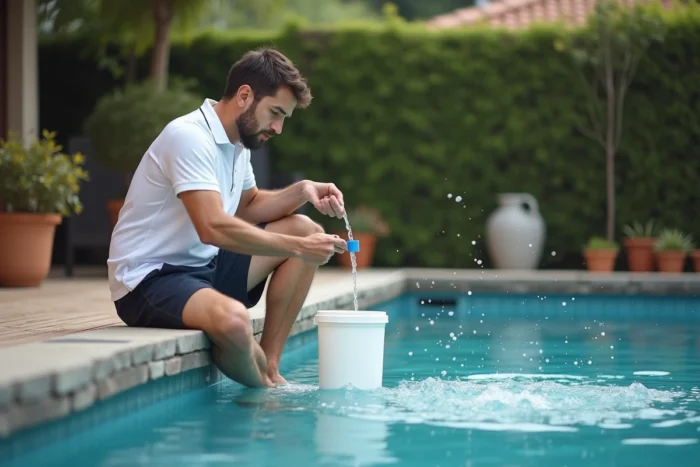
- Always apply the corrector with filtration running, distributed over several points in the pool to avoid localized concentration areas.
Baking soda and sodium percarbonate are not interchangeable. Baking soda targets alkalinity with a moderate effect on pH. Percarbonate releases sodium carbonate (more pronounced pH effect) and hydrogen peroxide (oxidizing effect). Choosing one or the other depends on the initial diagnosis.
Dosage of percarbonate in pools: why gradual application changes everything
Sodium percarbonate does not come with a standardized pool instruction manual, unlike pH+ products sold in specialty stores. Therefore, we work through controlled trial and error, and this is precisely where caution is necessary.
Add a small amount, wait several hours, retest. This is the only reliable method. The hydrogen peroxide released by the percarbonate temporarily interferes with pH readings on certain test strips. Retesting too quickly gives a distorted result.
Common mistakes that waste time
Pouring all the product in one spot, in front of the return jet, causes a very localized pH increase. The rest of the pool remains unchanged. You think it hasn’t worked, you add more, and the pH ends up rising well above the target.
Another trap: using percarbonate in a stabilized chlorine pool without considering the oxidizing effect. Hydrogen peroxide partially degrades active chlorine. It is better to treat in the evening, when UV rays are no longer affecting the disinfectant, and retest the chlorine the next morning.
Percarbonate or commercial pH+: when to choose one over the other
The pH+ sold in garden centers or pool stores is generally pure sodium carbonate, sometimes packaged in fast-dissolving granules. Its dosage is documented by the manufacturer, and its sole function is to raise the pH. For a pool whose pH regularly drops, it is the most predictable choice.
Percarbonate is most useful when a dual action is needed: raising a slightly low pH while treating water that is starting to cloud or turn green. The active oxygen released helps eliminate organic matter and slows the development of budding algae.
Feedback varies on this point, but it is observed that percarbonate works better as a supplementary treatment than as a regular corrector. In a pool where the pH drops below 7.2 every week despite a correct TAC, an automatic pH regulator remains the most reliable solution in the long term.
Sodium percarbonate has its place in pool maintenance, provided it is not asked to do what it cannot. Its role is that of a sporadic corrector with an oxidizing bonus, not that of a permanent stabilizer. Checking the TAC/pH pair before any intervention, dosing gradually, and retesting after a sufficient delay: these three reflexes avoid most disappointments.