
Natural care for pets refers to the range of products and practices based on plants, plant extracts, or non-synthetic preparations used to maintain the health and comfort of dogs and cats. Their appeal lies in a compatibility that is often better with animal skin and metabolism, provided that the contraindications specific to each species are respected.
Animal Phytotherapy: What the Skin of Dogs and Cats Can Really Tolerate
The skin of dogs has a more alkaline pH than that of humans, while that of cats shows increased sensitivity to aromatic compounds. This fundamental difference explains why a natural remedy effective on a dog can provoke a reaction in a cat.
Concentrated essential oils are toxic to cats, as their liver lacks the necessary enzymes for metabolizing them. Tea tree, cinnamon, and eucalyptus are among the most risky substances. For dogs, these same oils can be used in very low dilution in a vegetable base, but never in pure application.
Some owners confuse “natural” with “safe.” However, a lavender hydrosol suitable for dogs may not necessarily be appropriate for a cat. Before any use, checking the list of contraindicated plants for the species in question remains a non-negotiable prerequisite. A veterinarian trained in phytotherapy can guide the choice accurately.
To explore a dedicated range, pet care with La Fibre Câline offers formulations designed for the daily well-being of animals.
Aloe Vera Gel and Oil Macerates: Natural Care for Animal Skin
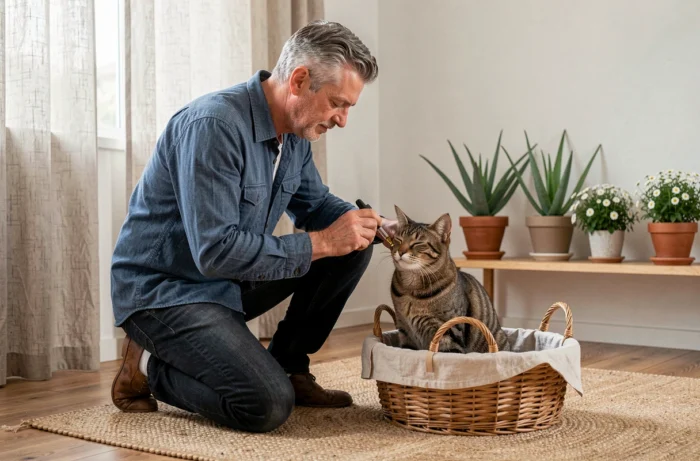
Aloe vera gel is one of the most versatile topical treatments for dogs. Applied to a skin irritation, a scratching area, or a small superficial wound, it soothes and promotes healing thanks to its moisturizing and anti-inflammatory properties.
For cats, aloe vera should never be ingested: the molecule aloin, present in the outer layer of the leaf, causes digestive disturbances. Purified gels (without aloin) can be applied to the skin, but licking must be prevented during the absorption phase.
Oil macerates of calendula and St. John’s wort represent two other relevant options. Calendula soothes superficial dermatitis and post-grooming irritations. St. John’s wort acts on mild muscle pain, with gentle massage on the joints of an aging dog.
- Calendula oil macerate: suitable for reactive skin, applicable after a bath or grooming on reddened areas
- St. John’s wort: local anti-inflammatory properties, useful for massage on sensitive joints of older dogs
- Purified aloe vera (without aloin): hydration and healing of skin irritations, with caution in cats
Bach Flowers and Animal Stress: A Regulated Use
Bach Flowers are diluted floral elixirs used to regulate emotional states in animals. Rescue Remedy, a blend of five flowers, is the most common in complementary veterinary practice. A few drops in the water bowl or directly on the gums can alleviate an episode of acute stress: transport, thunderstorm, visit to the veterinarian.
Their mechanism of action remains debated scientifically. No large-scale study has definitively validated their effectiveness in animals. Their main advantage lies in the absence of known side effects, making them a first-line option before resorting to an anxiolytic.
Chronic stress requires a veterinary diagnosis, not just a floral elixir. A dog that destroys objects in the absence of its owner or a cat that urinates outside its litter box may suffer from a deep behavioral disorder that Bach Flowers alone will not resolve.

Plant-Based Diet for Dogs and Cats: What Recent Studies Say
A review published in the scientific journal Animals in 2026, covering 31 studies, concludes that dogs and cats can digest plant-based foods well, provided that the formulation is balanced and nutritionally validated. This result has been reported by several media outlets, including Excelsior in July 2026.
The global market for plant-based pet food reached $26.9 billion in 2024, with an expected annual growth of 7.8%. This trend reflects a growing interest in plant-based products in the diet and care of pets.
Be careful not to confuse plant-based diets formulated by veterinary nutritionists with an improvised “homemade” diet. A dog fed cooked vegetables without supplementation of taurine, vitamin B12, or sulfur-containing amino acids risks serious deficiencies. The cat, a strict carnivore, has even more demanding nutritional needs for animal-derived nutrients or specific synthetic supplements.
European Regulation and Plant-Based Veterinary Care
In August 2026, the Spanish Medicines Agency (AEMPS) published a guide facilitating simplified registration requests for traditional herbal veterinary medicines and homeopathic products. This initiative is part of the European regulation on veterinary medicines.
In France, not all veterinary phytotherapy products have the status of medicine. Many are marketed as dietary supplements or hygiene products, which eases market entry constraints but also reduces guarantees of proven efficacy. Reading labels carefully allows distinguishing a product that has undergone evaluation from a simple cosmetic claiming soothing properties.
The European regulatory trend is moving towards better recognition of natural veterinary care, but diagnosis remains the veterinarian’s act. Natural care complements medical management; it does not replace it. Choosing products with transparent composition and suitable for the targeted species remains the best guarantee of safe use.