
The +30 dialing code regularly appears on phone screens, often without immediate knowledge of which country it corresponds to. Identifying an international dialing prefix allows for filtering incoming calls, calling back at the right rate, and avoiding scams. This article details the structure of the numbering plan associated with +30, the internal prefixes it comprises, and the applicable pricing framework from France.
Dialing Code +30: Country Correspondence and ITU Zone
The International Telecommunication Union (ITU) assigns codes by geographical zones. Zone 3 mainly includes countries from southern Europe and the Mediterranean region. +30 is the exclusive dialing code for Greece, assigned under the ITU-T recommendation E.164.
A two-digit code generally indicates a country with a high volume of calls in its zone. Greece shares the 3x range with other European countries, but no other state carries the code 30.
| Dialing Code | Country | ITU Zone |
|---|---|---|
| +30 | Greece | 3 (Southern Europe) |
| +31 | Netherlands | 3 |
| +32 | Belgium | 3 |
| +33 | France | 3 |
| +34 | Spain | 3 |
This table shows that the codes 30 to 34 cover five contiguous European countries in the numbering plan. Knowing that +30 is just before +31 (Netherlands) helps with memorization through proximity.
To understand in detail which country corresponds to the +30 dialing code, one must also examine the internal structure of Greek numbers, which differs significantly from the French model.

Greek Numbers in +30: Structure Without Trunk Prefix Since 2002
Greece removed its internal trunk prefix (the initial “0”) in the early 2000s. Since 2002, all Greek numbers consist of 10 complete digits, composed identically for national and international calls. The only difference: the addition of +30 before the number for calls from abroad.
In France, calling a Greek mobile means dialing +30 followed by the 10 digits, without removing any zeros. This feature reduces dialing errors compared to countries where the trunk zero must be removed (like France itself with its +33).
Fixed and Mobile Internal Prefixes
Greek numbers follow stable internal prefixes that help identify the type of line and the region of origin for an incoming call.
- Mobiles: prefix 69x (for example +30 69x xxx xxxx). All Greek mobile phone numbers start with 69, regardless of the operator.
- Fixed: prefix 2xx, with sub-prefixes by city. 21 designates Athens, 231 Thessaloniki, 241 Volos, 261 Patras, 281 Heraklion.
- A number in +30 starting with a digit other than 2 or 6 may correspond to a special service or a premium number, which warrants increased caution before calling back.
This prefix logic makes identifying a Greek call quite reliable. A number in +30 21x likely comes from an Athens landline, while a +30 69x is a mobile.
Call Pricing to Greece from France
As Greece is a member of the European Union, calls made from France to a +30 number benefit from the European regulatory framework on intra-EU communications. The pricing for voice calls to Greece is capped by European regulation, which limits the surcharges compared to a call to a non-EU country.
However, this cap only applies to calls made from French territory. A call made from a third country to a Greek number falls under the operator’s standard international rate, which is often much higher.
Incoming Calls While Roaming in Greece
Since the elimination of roaming charges in the European Economic Area, a French subscriber in Greece can receive and make calls under the terms of their national plan, within reasonable usage limits. Roaming in Greece does not incur additional costs for plans that include Europe.
This distinction between calls made from France to Greece (capped) and calls while roaming in Greece (included in the plan) often causes confusion. The first case falls under intra-EU pricing, while the second pertains to roaming.
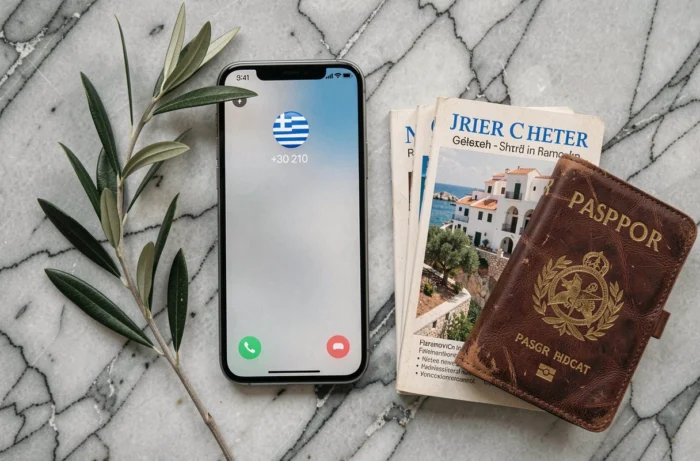
Identifying a +30 Call: Quick Method
When an unknown number appears with the +30 prefix, three successive checks can help locate it.
- Confirm the country: +30 corresponds to Greece, without exception or sharing with another territory.
- Identify the type of line: if the two digits following +30 are 69, it is a mobile. If they start with 2, it is a geolocatable landline (21 for Athens, 231 for Thessaloniki, etc.).
- Check the length: a valid Greek number has exactly 10 digits after +30. A number that is shorter or longer is suspicious.
This analysis grid works without third-party applications. It relies solely on the official structure of the Greek numbering plan, stable since 2002.
The +30 remains one of the easiest European dialing codes to identify due to its unique assignment to Greece and the regularity of its internal prefixes. The removal of the trunk zero over twenty years ago further simplifies dialing: the number displayed on the screen is the one to call back, preceded by +30, without any additional manipulation.