
Buying a serum, cream, or hair care product online takes just a few clicks. Choosing the right product for your skin, hair, or body requires a bit more method. The cosmetics sold online number in the tens of thousands of references, spanning brand sites, marketplaces, and specialized pure players. This guide provides you with concrete benchmarks to filter this offer and order with confidence.
Read the INCI list before looking at the packaging
Most beauty guides start with skin type. Before getting there, a more useful reflex is to turn the bottle around, even virtually. On an online product page, the INCI list (International Nomenclature of Cosmetic Ingredients) is often accessible in a “composition” or “ingredients” tab.
Have you noticed that the first names on this list often come up? That’s normal: ingredients are listed in descending order of concentration. If the active ingredient highlighted on the packaging (hyaluronic acid, niacinamide, shea butter) appears at the end of the list, its presence is negligible.
Two quick checks to make before adding a product to your cart:
- Count the total number of ingredients. A short formula (fewer than fifteen components) limits the risk of controversial substances and is better suited for sensitive skin.
- Identify declared allergens, often grouped at the end of the list under their Latin or chemical names. Synthetic fragrances (fragrance, parfum) are among the leading causes of skin reactions identified by dermatologists.
- Look for the mention of a label (Cosmos Organic, Ecocert, Nature et Progrès) directly on the product page. A certified organic label guarantees a verifiable specification, unlike the claims “natural” or “clean” which have no regulatory definition.
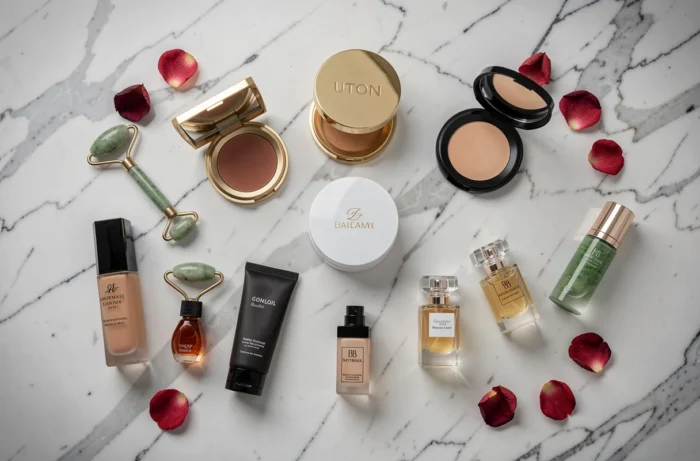
To browse a catalog that includes face, body, hair care, and perfumes with this information accessible, you can discover the Cosmétiques Beauté site and compare product sheets before purchasing.
Online skin diagnosis: what works and what is marketing
More and more sites offer a questionnaire or skin diagnostic tool before recommending treatments. The idea is appealing. The reality deserves some nuance.
A well-designed questionnaire asks at least five targeted questions: area of the face concerned, level of perceived sebum, reactivity to temperature changes, allergy history, current routine. If the form has only two or three vague questions before suggesting a cart, it serves sales more than your skin.
Virtual try-on tools (foundation shade simulation, lipstick rendering via camera) have significantly improved. They remain reliable for makeup, much less so for treatments. No algorithm can replace a dermatological diagnosis when it comes to identifying atopic skin, rosacea, or eczema.
Why does this detail matter? Because a poor online diagnosis can lead you to products that are too aggressive for your skin. A cream formulated for oily skin applied to dehydrated skin exacerbates tightness instead of resolving it.
Organic, natural, clean cosmetics: decoding online claims
The term “organic” applied to cosmetics follows specific rules in Europe. A product certified organic by a recognized organization (Ecocert, Cosmos) meets a minimum percentage of natural and organic ingredients, along with a list of prohibited substances.
The terms “natural” and “clean beauty” are not regulated. A soap can claim “100% natural” while containing synthetic preservatives if the manufacturer considers the base to be natural. Online, where you cannot turn the packaging in-store, this distinction is even harder to spot.
For pregnant women or products intended for children, vigilance increases. Some identified endocrine disruptors (long-chain parabens, certain UV filters) remain permitted in conventional cosmetics. Organic labels systematically exclude them from their specifications.
A simple guideline: if the online product sheet does not mention either the label name or the certificate number, the claim “organic” or “natural” only reflects the brand’s marketing discourse.

Purchase safety and European regulations on online cosmetics
Since the implementation of the GPSR (General Product Safety Regulation) in the European Union, online cosmetic sellers must provide more comprehensive traceability information on their product sheets. In practical terms, this means that the name and address of the manufacturer or responsible person must appear on each sheet.
If you order from a marketplace, check that the third-party seller displays this information. Its absence is a warning sign, especially for products imported from outside the EU. The European cosmetics regulation (Regulation EC 1223/2009) also requires the declaration of each product on the CPNP (Cosmetic Products Notification Portal) before it is placed on the market.
Three points to check on an online sales site before paying:
- The presence of a physical address of the seller or the responsible person for the product in the EU, not just a P.O. box.
- A visible batch number on the sheet or on the product received, allowing traceability in case of a recall.
- The period after opening (PAO), represented by the small open jar with a number (6M, 12M), indicating the duration of use after first opening.
Buying cosmetics online now represents the second largest e-commerce category in Europe according to NielsenIQ, behind food. This rapid growth has multiplied the sellers and available references. More choices imply more vigilance regarding the reliability of the seller, not just the quality of the product.
The most cost-effective reflex remains to cross-reference two sources of information: the composition displayed on the product sheet and an independent review (ingredient analysis app, verified reviews, recommendation from a healthcare professional for specific treatments). A beautiful site does not guarantee a good product, but a complete and transparent product sheet remains the best accessible indicator before clicking “add to cart”.