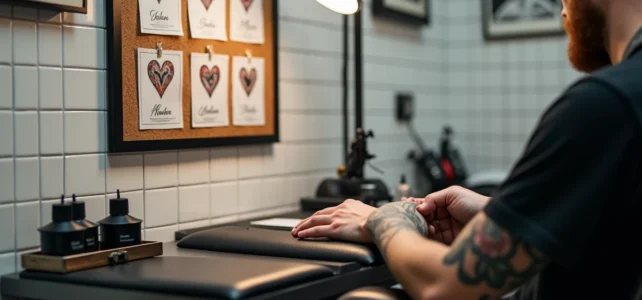
The heart tattoo with a name is conceived as a micro-narrative etched into the skin. Every typographic choice, every graphic element added to the design alters the interpretation of the drawing. Here, we present twelve concrete approaches focused on co-creation with the tattoo artist and the technical decisions that differentiate a generic design from a truly personal tattoo.
1. Continuous line heart with name integrated into the outline
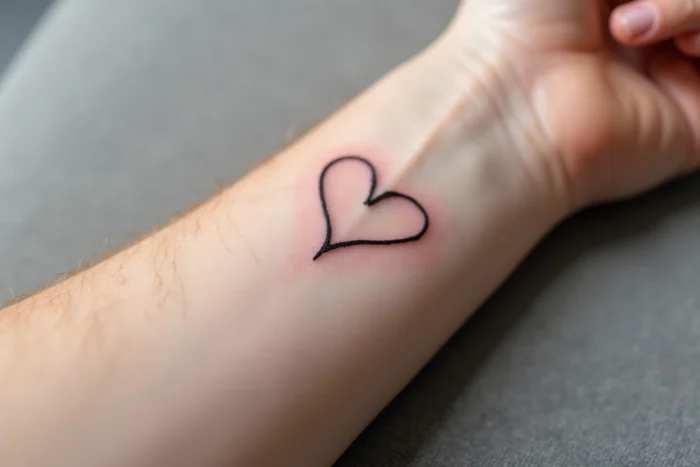
The principle is based on a single line drawing where the name is part of the heart’s contour itself. The initial letter starts the line, the following letters follow the curve, and the final point of the name completes the shape.
This style requires a fluid cursive typography. The tattoo artist must calibrate the thickness of the line so that the letters remain legible from a distance while maintaining the illusion of a single stroke. We recommend placement on the inner forearm or collarbone, flat areas that preserve the continuity of the line.
To explore other graphic avenues around the original heart tattoo with name, this guide details several symbolic variants and their adaptations.
2. Anatomical heart with name on a banner
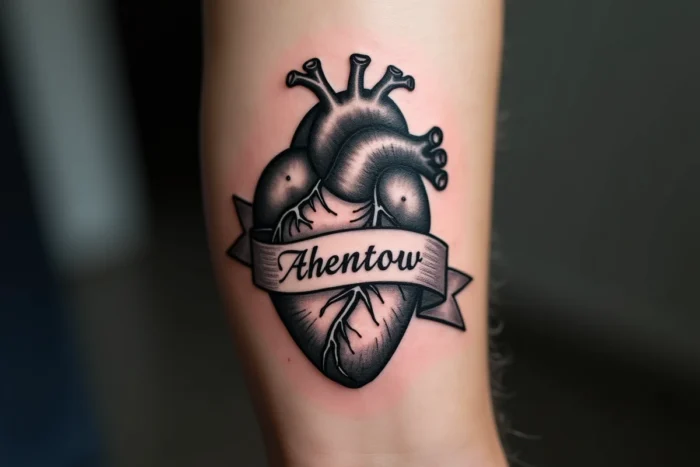
The anatomical heart brings a raw, organic dimension. The name is inscribed on a banner wrapped around the arteries or crossing the ventricle, reminiscent of reimagined traditional American tattoos.
The rendering requires a tattoo artist comfortable with realistic shading. The contrast between the realism of the muscle and the typography of the banner creates a graphic tension that tells something more visceral than a simple stylized heart.
3. Minimalist heart on the finger with initial
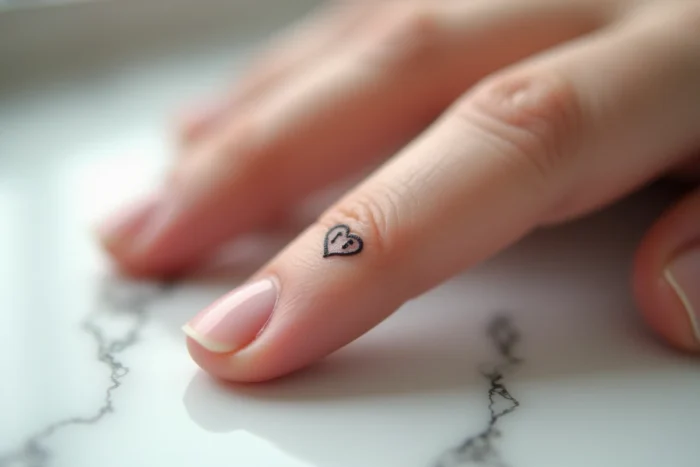
On the phalanx, the space requires reducing the name to just its initial, placed inside or just next to a micro-heart. The line must remain thin but deep enough to withstand the rapid wear of the skin on the hands.
This placement wears out faster than other areas. We recommend testing first with a temporary tattoo for a few days, a practice increasingly common to validate the rendering on visible areas like the finger, wrist, or collarbone.
4. Lace heart with name in serif lettering
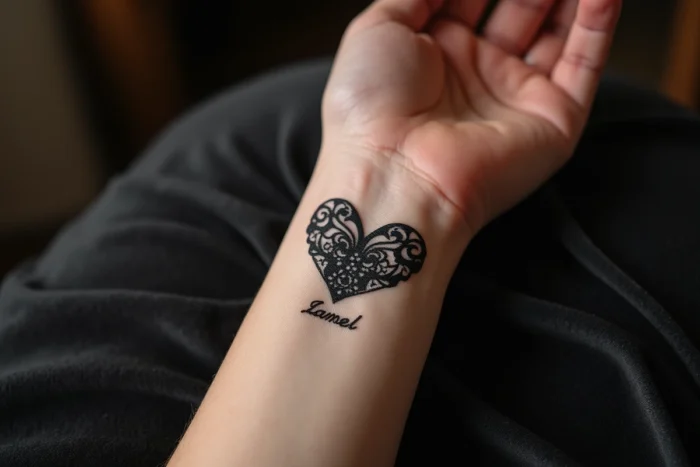
The lace pattern transforms the heart into a tattooed textile piece. The arabesques create an ornamental frame in which the name in serif letters (with straight serifs, engraving style) provides a classic anchor.
This design works particularly well on the shoulder, under the breast, or on the thigh, areas that offer the necessary surface for lace details. The dialogue between the delicacy of the pattern and the legibility of the name constitutes the main challenge of co-creation with the tattoo artist.
5. Geometric heart with name in modern capitals
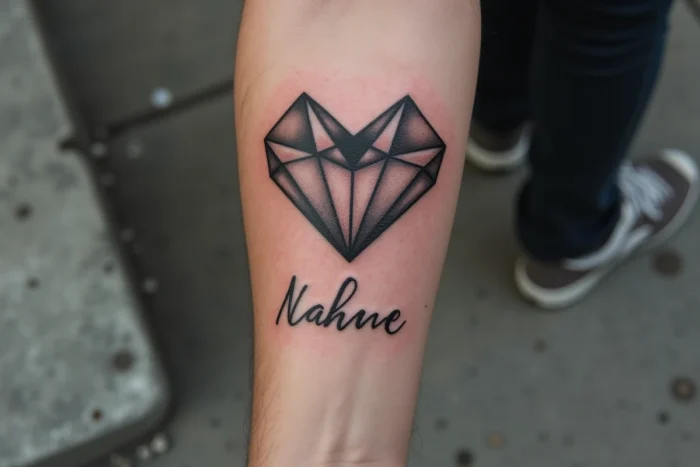
The heart is constructed from triangles, straight lines, and polygons. The name in sans-serif typography, spaced capital letters, enhances the graphic and contemporary character of the drawing.
The geometric alignment does not forgive approximation. The tattoo artist works with a stencil using precise markers. The arm or calf offers sufficiently stable surfaces so that the straight lines do not distort with muscle movements.
6. Watercolor heart with name in handwritten script
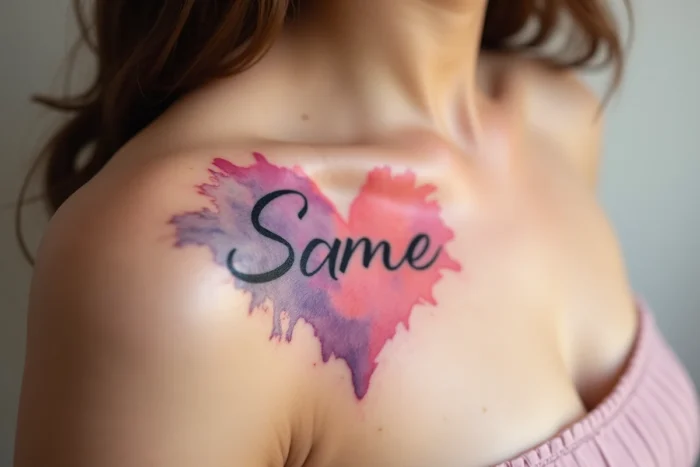
Color splashes mimic watercolor around a heart whose contours dissolve. The name, traced in personal handwritten script (sometimes reproduced from a loved one’s actual handwriting), floats in the center or below.
This style ages differently than black tattoos. Light pigments fade, giving the design a deliberately ephemeral appearance after a few years. It should be embraced as an aesthetic choice, not as a flaw.
7. ECG heartbeat heart with name integrated into the line
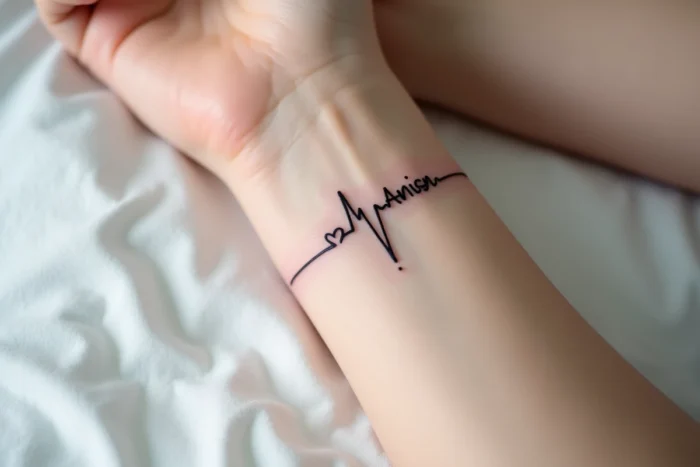
The electrocardiogram line draws a peak that transforms into a heart, and the name is inscribed along the flat line that follows. The result evokes both life and attachment to the named person.
The inner wrist remains the most requested placement for this design. The fineness of the line requires a small caliber needle and a tattoo artist experienced in precise line work on thin skin.
8. Intertwined double heart with two names
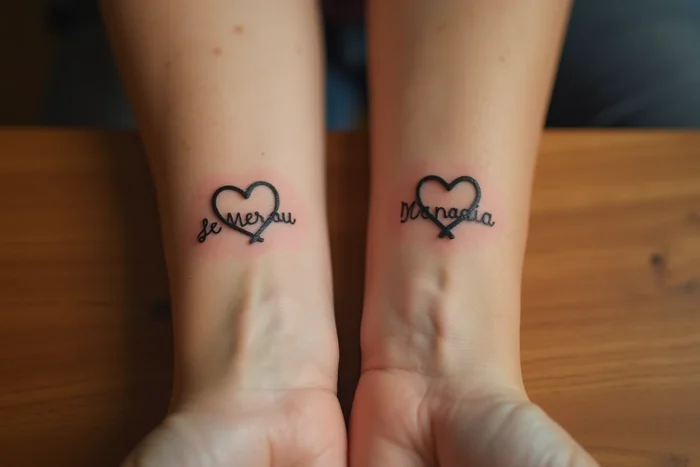
Two overlapping hearts, each bearing a distinct name, tell a story of a relationship. The intersection of the shapes creates a common area where the letters can partially overlap.
The technical difficulty lies in the legibility of both names despite the intertwining. We recommend using two slightly different typographies (one cursive, one script) to visually distinguish each name without cluttering the design.
9. Floral heart with name and birth flower
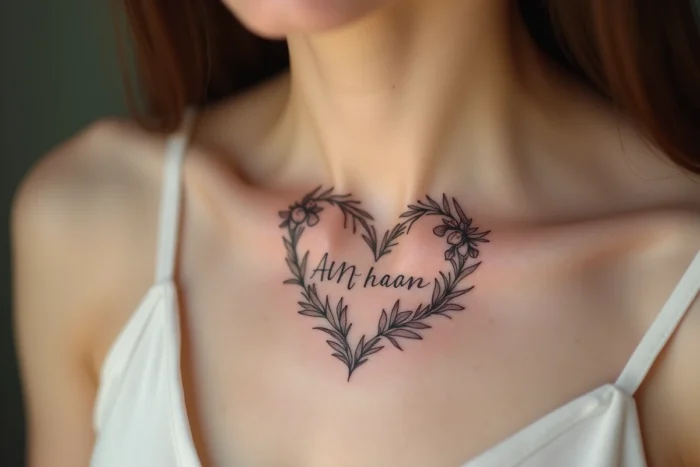
Designs combine a heart, a name, and a flower associated with the birth month of the tattooed person or loved one. The heart is formed from stems and petals, with the name integrated as a botanical label.
This approach anchors the tattoo in verifiable personal symbolism (the flower for January is not the same as for June). Fine floral line art, in a detailed minimalist style, remains the most requested rendering in this category.
10. Fingerprint heart with name in an arc
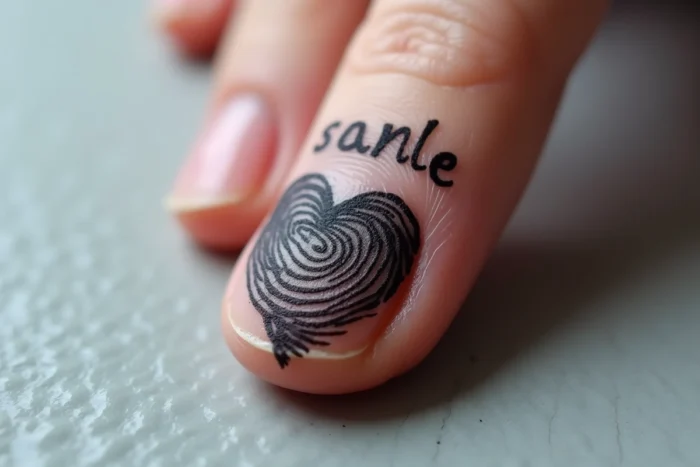
The heart consists of the lines of a real fingerprint, reproduced from an ink impression. The name follows the upper curve of the heart in an arc.
This design pushes personalization to its maximum. The tattoo artist digitizes the fingerprint, modifies it to be legible as a heart, and then positions the name. The result is a literally unique tattoo.
11. Negative heart (ink around, bare skin in the center) with name in reserve
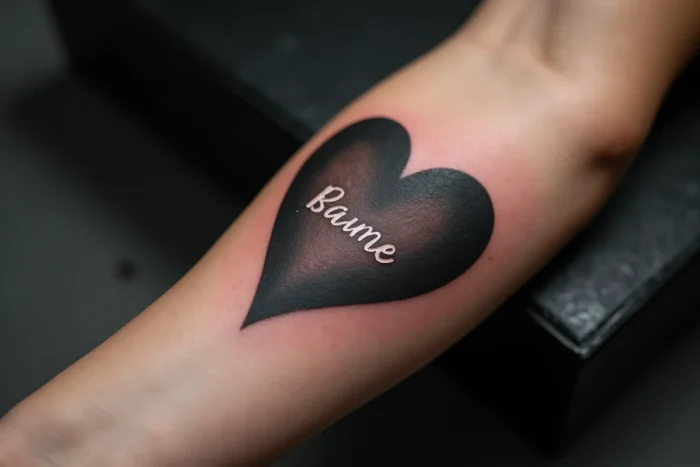
The heart is not inked: it is the bare skin that shapes the form, surrounded by a solid black area or a dense pattern. The name also appears in reserve, in uninked letters.
This style reverses the usual logic. It requires mastery of filling to ensure that the edges of the heart and letters remain sharp. The contrast works best on light to medium skin.
12. Chain heart with name as a pendant
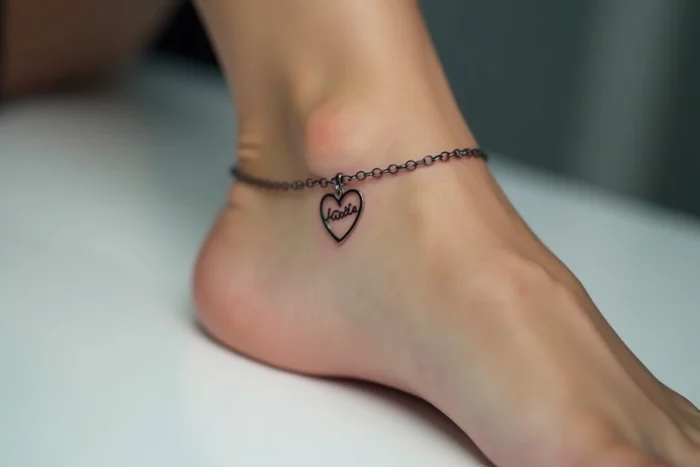
A fine chain tattooed around the wrist, ankle, or neck ends with a heart-shaped pendant bearing the engraved name. The trompe-l’œil jewelry gives the tattoo a permanent ornamental function.
The name is engraved in very small letters inside the pendant. The tattoo artist must anticipate the minimum size below which the letters will merge over time. A preliminary test on tracing paper, placed directly on the skin, allows for scale adjustments before inking.
Each of these twelve approaches relies on a technical dialogue with the tattoo artist, not on a catalog choice. Typography, body area, graphic style, and symbolic elements added to the heart form a complete narrative. Before engraving a name, the most useful question remains that of legibility in ten years, far more than that of the rendering on the day of the session.