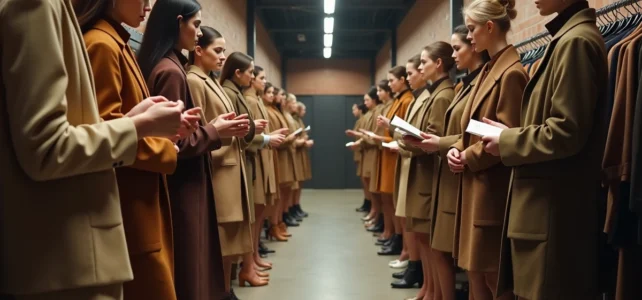
The number of models walking on a runway varies so much from one show to another that no official average exists in industry databases. Specialized platforms like Tagwalk document each fashion show by the number of looks presented, not by the number of models engaged. This distinction, often overlooked, changes how one can answer the question.
Number of looks and number of models: two distinct data points
A haute couture show can present several dozen silhouettes. Each silhouette corresponds to a walk on the runway, but the same model can wear two, three, sometimes four different outfits during a single show. Counting looks does not equate to counting models.
In practice, when trying to estimate the number of models in a fashion show, one must first identify the format of the show. A house that showcases around forty looks with quick changes backstage may mobilize about twenty models. Another, which avoids outfit changes for reasons of stage rhythm, will recruit as many models as there are walks.
The number of looks almost never corresponds to the number of models. The dressers backstage, the complexity of the outfits, and the tempo of the show determine how many changes are feasible.
Haute couture, ready-to-wear, independent: very different formats
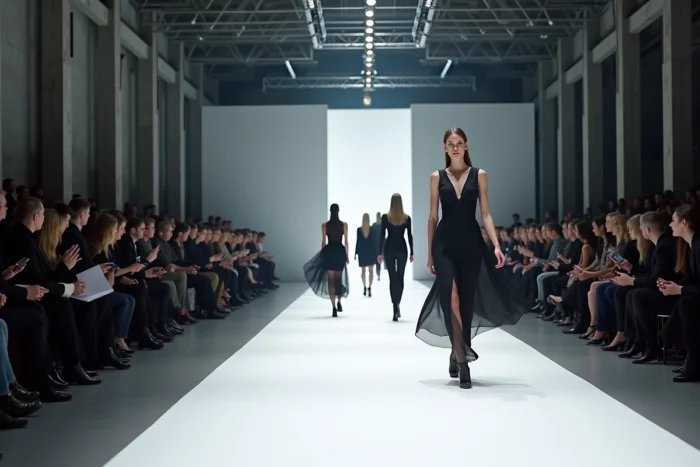
Variability is the dominant trait. A house like Chanel or Dior, during Paris Fashion Weeks, regularly presents several dozen silhouettes. The casting then involves a significant number of models, including several recurring faces who open or close the show.
In contrast, independent shows and slow fashion events in France often revolve around about twenty models. This figure appears in feedback from fashion event producers in Marseille or Lyon, where budgets directly constrain the size of the casting.
- Major luxury houses (Paris, Milan) frequently mobilize between thirty and sixty models, sometimes more for spectacular shows with few outfit changes
- Mid-range ready-to-wear brands typically have between fifteen and thirty models, with changes backstage
- Associative, school, or young designer shows often fall below the fifteen model mark, with some limiting themselves to about ten
The actual range extends from about ten to over fifty models depending on the segment. Speaking of a single average makes little sense without specifying the type of show.
Production budget and model casting: the direct link
Caroline Lefrere, founder of the Hermana Agency, specialized in scenography and fashion show production, indicated to Fashion United that below 50,000 euros, it is almost impossible to produce a show. This budget floor includes the venue, technical aspects, communication, but also the casting.
The model budget represents a significant portion of the total budget. Each model must be paid, dressed, styled, and made up. Multiplying the walks also implies multiplying the dressers and backstage staff. For a young designer with a tight budget, reducing the number of models is one of the first adjustments.
Why some houses deliberately inflate the casting
The most publicized shows do not seek budget efficiency. A large casting allows for showcasing a diversity of body types, including known faces that generate press coverage, and creates a mass stage effect. The number of models thus becomes a communication tool as much as a creative necessity.
Some houses also invite non-model personalities (actors, musicians, athletes) to walk the runway, which artificially inflates the count without these participants being professionals on the runway.
Why no database publishes a reliable average
Tagwalk, the main database for fashion shows, catalogs looks, brands, and individual models. Each show is documented with precision. However, the available data does not allow for calculating a consolidated average, and for a simple reason: the formats of shows are too heterogeneous for an average to have descriptive value.
A Valentino show in Rome and a graduation show at a fashion school in Paris do not belong to the same category. Aggregating them in an average calculation would produce a figure without operational significance.
Field feedback also diverges on this point. Casting directors from major houses reason in terms of the number of looks and the profiles of models (exclusivity, notoriety, morphology). The total number of models is a consequence of these choices, not a goal in itself.
What specialized tools still allow us to observe
- Major houses present between thirty and sixty looks per season, with a model/look ratio that varies from 1:1 to 1:3 depending on backstage logistics
- Paris Fashion Week shows mobilize on average more models than regional or thematic fashion week shows
- The recent trend pushes some brands to reduce the number of walks to extend the exposure time of each silhouette, which mechanically decreases the casting
Answering the initial question thus requires segmentation. For a major house show during a major Fashion Week, the casting most often revolves around thirty to fifty models. For an independent or emerging event, around twenty models is a common format. These orders of magnitude remain estimates, dependent on budget, venue, artistic concept, and show duration.