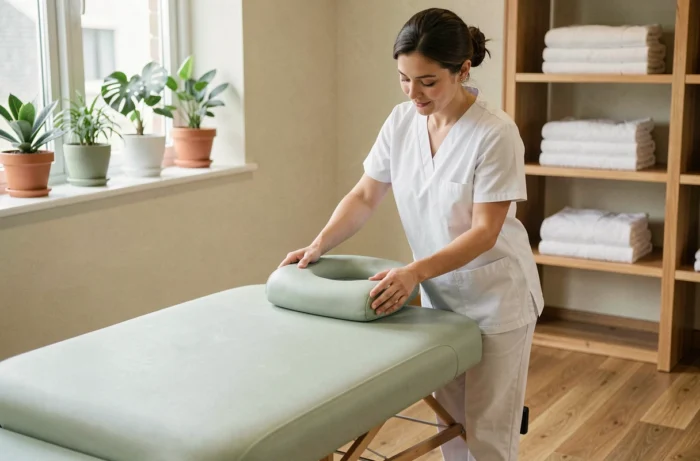
A massage table that creaks at the slightest pressure, a mattress that is too thin and lets the structure be felt, an inappropriate height that forces constant bending: these details turn every session into a source of fatigue. Choosing the right massage table is essential for protecting both the client’s comfort and the practitioner’s health in the long term.
Practitioner Ergonomics: Table Height as a Preventive Tool
Have you ever felt tension in your lower back after a day of massages? The height of the table is often the direct cause. A table that is too low forces you to bend your back, while a table that is too high contracts the shoulders and wrists.
The basic rule: standing with your fists resting on the mattress, your elbows should remain slightly bent. This simple reference avoids most awkward postures.
The adjustable height protects the lower back, neck, and wrists of the practitioner, three areas frequently affected by musculoskeletal disorders. Electric adjustment models allow you to change the position without interrupting the session or breaking the rhythm of the treatment. For a mobile practitioner or one in a shared office, this feature significantly improves daily work quality.
By browsing the available ranges, you can discover the site La Table De Massage which lists various models suited to each practice.
Stability of the Massage Table Under Real Pressure
One point that many guides overlook: stability cannot be judged when empty. It must be tested during applied maneuvers, when the practitioner exerts firm pressure on a specific point of the body.
An unstable table disrupts the pressure applied and creates a risk of discomfort for the client. Worse, it can cause sudden movements that force the practitioner to compensate by straining their joints.
To assess stability, two elements matter more than anything else:
- The feet or base of the structure must remain perfectly still when strong pressure is applied at the center and on the edges of the mattress, not just when the table is placed without load.
- The tension cables (on wooden folding models) or cross braces (on aluminum structures) stiffen the whole and limit lateral swaying.
- The maximum client weight announced by the manufacturer should leave a comfortable margin compared to your usual clientele.
A test in-store or at a trade show, simulating lateral pressures and central pressures, is worth more than any technical sheet.
Mattress and Covering: What Determines Client Comfort
The mattress is the part that the client directly feels. If it is too thin, it reveals the rigid structure. If it is too soft, it absorbs the practitioner’s pressure and reduces the effectiveness of the massage.
A medium-density mattress offers the best compromise between comfort and firmness. High-resilience foam returns to its original shape between each session, whereas entry-level foam collapses after a few months of regular use.
The covering deserves equal attention. Synthetic leather (PU or PVC) dominates the market for a simple reason: it cleans quickly between clients. Some coverings incorporate a stain-resistant treatment or are more resistant to massage oils.
Why does this choice matter so much? Because a covering that cracks or absorbs oils after a few months gives the client an impression of neglect, even if the practitioner is excellent. The covering is the first thing the client touches when settling in.

Folding or Fixed Massage Table: Adapting the Choice to Your Workspace
The question is not the same for a practitioner in a fixed office and for a practitioner who travels to clients’ homes.
A fixed table, heavier and wider, naturally offers better stability and superior comfort. It is suitable for dedicated spaces where the table remains in place.
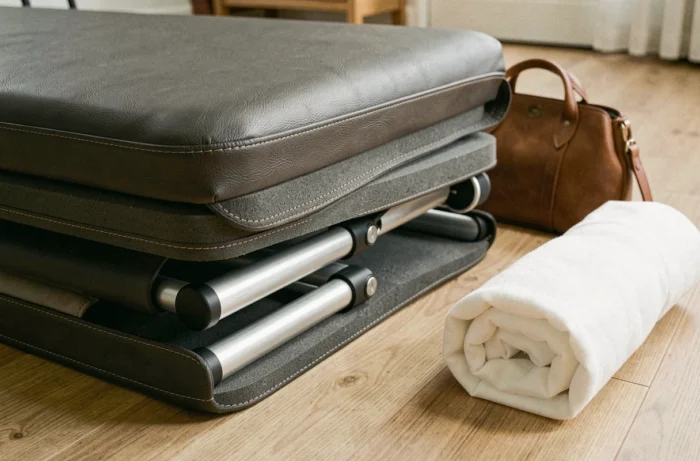
A folding table is suitable for mobile practitioners as long as you check its weight and folded size. Transporting a heavy table several times a day, going up stairs with it, loading it into a trunk: these repeated actions matter as much as the quality of the table itself.
- Aluminum structures are lighter than wooden structures, but sometimes less stable under heavy pressure.
- Maple is a dense wood that ensures robustness and durability, often used in high-end models.
- The width of the folding table should allow the client to rest their arms alongside their body without overhanging, while still being transportable.
For dimensions, most tables offer a standard width that suits the majority of body types. If you regularly receive clients of larger build, a width greater than standard significantly improves their comfort.
Removable Headrest or Integrated Facial Cavity
The removable headrest adapts to several positions and is removed when the client is on their back. The integrated facial cavity in the mattress offers a more stable support in the prone position but limits versatility.
The choice depends on the techniques practiced: a practitioner who frequently alternates the client’s positions will prefer the headrest. A practitioner specializing in back massage will favor the integrated cavity for its stability.
The last criterion, often overlooked: check that the foam of the headrest or cavity maintains its density over time. This is the area that supports the weight of the head throughout the session, and collapsed foam can cause neck pain for the client.