The home care for seniors relies on a range of services whose nature, regulatory framework, and cost vary depending on the type of structure requested. With 82,776 home service organizations recorded in France as of January 1, 2025, and a sector generating 22.8 billion euros in revenue in 2024, the offer has never been broader. The challenge remains to assess what this expansion concretely changes for the elderly and their families.
Provider, intermediary, direct employment: what each mode of intervention costs and involves
Three modes of intervention coexist for home assistance for seniors. Their differences lie in the legal status of the caregiver, the administrative responsibility of the family, and the remaining costs after assistance.
| Criteria | Provider mode | Intermediary mode | Direct employment |
|---|---|---|---|
| Employer of the caregiver | The service organization | The senior (or their family) | The senior (or their family) |
| Administrative management | Completely delegated | Partially delegated (recruitment, payroll) | Entirely the responsibility of the individual |
| Continuity of service | Replacement guaranteed in case of absence | Replacement sometimes offered | No guarantee of replacement |
| Indicative hourly cost | The highest of the three | Intermediate | The lowest, but employer charges to be borne |
| Eligibility for APA / social assistance | Yes | Yes | Yes |
The provider mode remains the most widespread because it completely relieves the family of employer obligations. On the other hand, direct employment allows for the free choice of the caregiver and negotiation of the hourly rate. The services offered by Your Health Assistant illustrate this logic of tailored support, where the care plan is built from the senior’s actual situation rather than a fixed catalog.
The intermediary mode is situated between the two: the organization recruits and manages payroll, but the senior retains the status of employer. This model suits families who wish to maintain oversight of the caregiver’s profile without bearing the administrative burden alone.

Reform of home autonomy services: what changes for senior support
Since 2023, the creation of home autonomy services (SAD) merges the former SAAD (daily assistance) and SSIAD (nursing care) into a single structure. The goal is to eliminate the boundary between daily living assistance and care, which until now forced families to coordinate two distinct contacts.
The law on measures to build a society for aging well has expanded the scope of home care. SAD can now intervene outside the home: cultural outings, accompaniment to medical appointments, participation in community activities. This change alters the very definition of home care, which is no longer limited to the private space.
Concrete impact on care coordination
With a single point of contact, the care plan integrates hygiene services, meal assistance, and nursing care. Coordination between caregiver and home helper no longer depends on two separate structures. For seniors with chronic conditions, this simplification reduces the risks of disruption in care.
The reform also includes a prevention component. SAD must propose actions against social isolation and loss of autonomy, which goes beyond the traditional framework of housekeeping or meal delivery.
Concrete criteria for evaluating a senior home support service
The increase in the number of organizations (18% growth in one year) makes the choice more complex for families. A few criteria allow for effective filtering of providers.
- The qualifications of caregivers: a qualified home helper (DEAVS or equivalent) ensures training in technical gestures (transfers, assistance with bathing) and in dealing with people experiencing loss of autonomy
- Continuity of service: check if the provider guarantees a replacement within 24 to 48 hours in case of absence of the usual caregiver, a crucial point for highly dependent seniors
- The actual scope of services: some organizations limit themselves to home maintenance, while others cover social support, administrative assistance, or cognitive stimulation
- Price transparency: a detailed quote, distinguishing between personal assistance hours and maintenance hours, allows for precise calculation of the remaining costs after deduction of the APA or tax credit
Evaluating these criteria requires a preliminary interview at the senior’s home. An effective care plan relies on an assessment visit, not on an online questionnaire.
Autonomy and social connection: the blind spot of standardized services
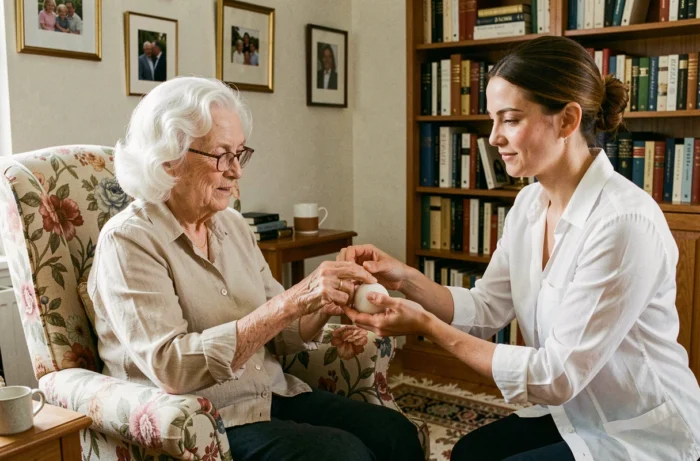
The majority of care plans focus on technical tasks: getting up, bathing, meals, going to bed. These services are necessary, but they only cover part of the real needs.
Social isolation accelerates the loss of autonomy comparably to certain chronic conditions. Tailored support includes regular outings, maintaining social activities, and, when possible, assistance in using digital tools to stay in touch with loved ones.
The role of the family caregiver in the system
Personalized support also considers the exhaustion of family caregivers. Respite solutions (day care, temporary accommodation) remain underutilized even though they help maintain the balance of the system over time. An exhausted caregiver jeopardizes the home care they are trying to preserve.
The reformed SAD now integrates this dimension into their specifications, with support actions for caregivers and coordination with local respite platforms.
The market for home services for seniors has never offered so many options. The difficulty has shifted: it is no longer about accessing a provider, but about the ability to identify one whose scope of intervention truly corresponds to the situation of the senior and their surroundings.