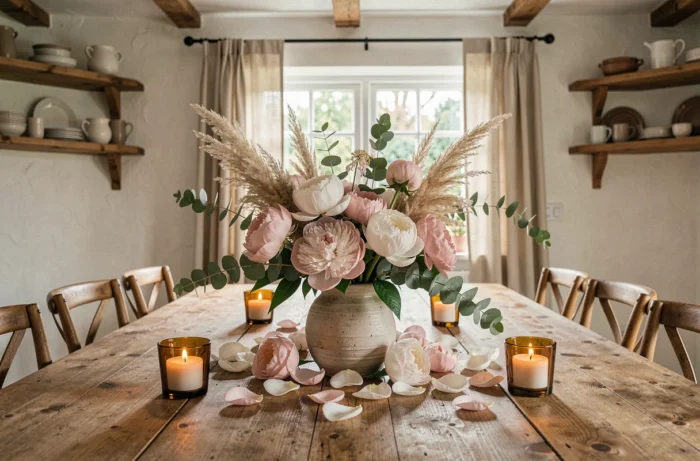
Floral decoration is no longer limited to a bouquet of fresh flowers placed on a living room table. With dried, preserved, and artificial flowers, the options have multiplied, each with its own constraints regarding durability, maintenance, and even taxation. Choosing a type of floral decoration for one’s interior today requires balancing aesthetics, long-term budget, and environmental impact.
Fresh, dried, or preserved flowers: how treatment affects lifespan and cost
The classic reflex remains the bouquet of fresh flowers, renewed every week or every two weeks. Over a year, the cumulative cost far exceeds that of a durable arrangement. Naturally dried flowers retain their appearance for several months, sometimes over a year if protected from moisture and direct light.
Preserved flowers undergo a conservation process using glycerin that replaces the sap. Their flexibility and colors remain close to fresh vegetation, but their unit price is significantly higher. A preserved arrangement lasts several years without maintenance, which changes the economic calculation compared to fresh flowers.
High-end artificial flowers have become more realistic in recent years. However, European regulatory constraints on microplastics increase pressure on manufacturers using synthetic materials, particularly glitter and certain plastic coatings. This factor, still not very visible to consumers, could gradually restrict supply or alter its composition.
To explore the different families of flowers and arrangements suitable for an interior, La Maison De Floran offers a catalog that covers both dried and preserved options, with indications on the expected lifespan of each creation.
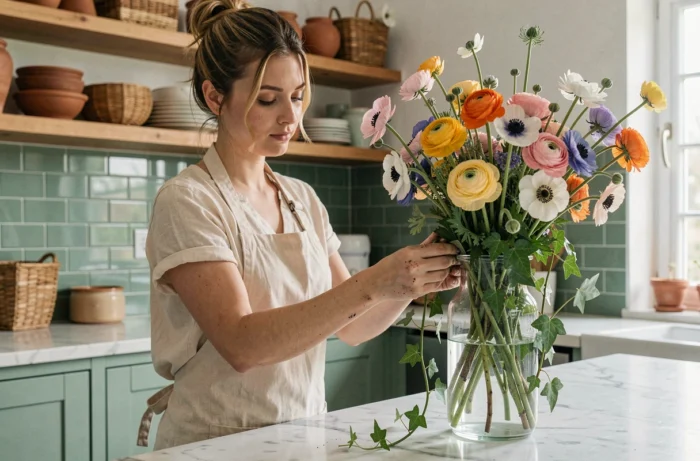
Floral decoration and taxation: the trap of arrangements mounted on supports
A point rarely addressed in decor guides concerns the tax treatment of flowers based on their degree of transformation. In France, naturally dried flowers and fresh flowers are not subject to the same VAT rate as transformed arrangements.
As soon as a flower is mounted on a decorative support (wreath, cushion, structured centerpiece), it falls into the category of transformed products. The decorative service is then distinguished from the simple sale of vegetation. This distinction requires professionals, both florists and interior decorators, to itemize their invoices.
For an individual purchasing a ready-to-use floral arrangement, the difference translates into a higher final price for elaborated pieces. A bulk bouquet of dried flowers sold as is will cost proportionately less, all else being equal, than a wall wreath assembled by an artisan.
What this means for an annual decoration budget
In practical terms, deciding between buying bulk dried stems and arranging them oneself in a vase, or ordering a composition mounted on a support, is not solely an aesthetic choice. The tax surcharge on transformed arrangements can represent a significant portion of the price for high-end artisanal pieces.
Field feedback varies on this point: some florists integrate the itemization without making it visible, while others detail it. Checking the price breakdown remains a useful reflex before making a substantial decorative purchase.
Floral trends 2026: asymmetry and mixed elements replace the round bouquet
Floral decoration is shifting towards more natural, asymmetrical, and deliberately imperfect compositions. The classic round bouquet, very structured, is giving way to arrangements that mix various textures and heights.
- The integration of fruits, berries, and aromatic herbs into compositions adds color, fragrance, and volume without relying solely on cut flowers.
- Artisanal ceramics with irregular shapes are gradually replacing transparent glass vases, altering the overall silhouette of an arrangement.
- Sensory compositions combine plant, mineral, and sometimes textile elements to create decorative pieces that no longer resemble a simple bouquet.
This evolution reflects a shift from “disposable decor” towards pieces designed as permanent elements of the interior. A centerpiece made of dried branches, natural berries, and a few stabilized stems can remain in place for several months without appearing wilted.
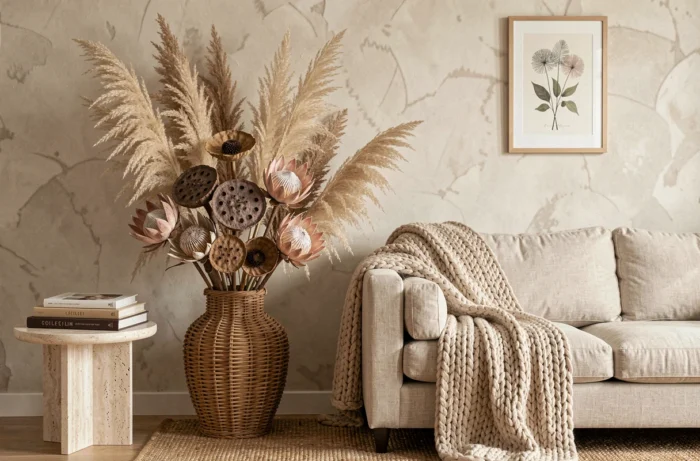
Artificial flowers and microplastics: a regulatory constraint to watch
Artificial flowers seem to be the most sustainable solution at first glance: no maintenance, no degradation, a one-time investment. The regulatory reality complicates this picture.
The European REACH regulation increasingly targets intentionally added microplastics in consumer products. Decorative glitter, certain coatings on synthetic petals, and plastic foams used as composition supports fall within the scope of these restrictions.
The available data do not allow for conclusions about the exact timeline for applying these regulations to all artificial floral decoration products. Some manufacturers are already anticipating by offering ranges without glitter or plastic coatings. For consumers, this means that choosing a high-end artificial flower today could become more limited or more expensive in the coming years.
Balancing between artificial and preserved
In the face of this regulatory uncertainty, preserved flowers occupy an interesting middle ground. They offer a longevity comparable to artificial (several years) while remaining transformed natural vegetation, thus outside the scope of restrictions on plastics.
Their limitation lies in their fragility: a preserved flower does not handle humidity and prolonged direct light well. In a naturally well-lit room, placing preserved compositions out of direct sunlight significantly extends their lifespan.
The choice between these four families (fresh, dried, preserved, artificial) ultimately depends less on personal taste than on a balance between renewal frequency, annual budget, and tolerance for maintenance constraints. An interior that mixes two or three of these categories, reserving fresh flowers for main living areas and preserved for less exposed spaces, remains the most balanced configuration economically and aesthetically.