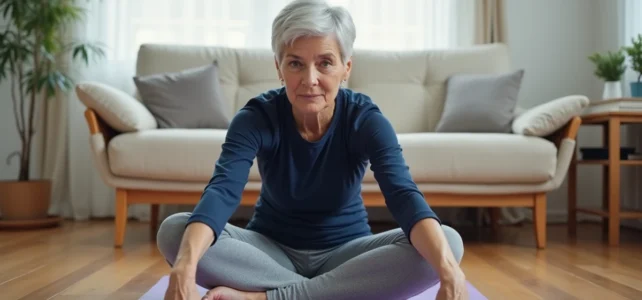
A senior who slips on the tiles in their bathroom may not lack motivation, but they do lack strength in their legs and hips. Most gentle home gym programs offer general movements to “stay fit,” without prioritizing what actually protects against falls. We can do better with fewer exercises, provided we target the right muscle groups and measure our progress.
Fall prevention exercises at home: a priority for seniors
The current trend in physical activity programs for seniors no longer focuses on the quantity of movements, but on a few specific functional gestures. Standing up from a chair without using the arms, the glute bridge, and secure single-leg support (held near a wall or countertop) have become key indicators for fall prevention.
What changes compared to a classic gentle gym session is the logic: these exercises also serve as progression tests. If one can stand up five times from a chair without using their hands, it’s a reliable signal of sufficient strength in the quadriceps and glutes. If one can hold a single-leg support for more than ten seconds, balance is improving. We know exactly where we stand, week after week.
To structure this type of work, one can rely on a senior physical activity program on Medic Com that details suitable sports for home and their concrete benefits.
Senior muscle strengthening without equipment: three key movements

No elastic bands or weights are needed to work on strength after age 60. Three bodyweight exercises, practiced regularly, cover the most used areas in daily life.
Assisted squat with chair
Standing in front of a chair, feet hip-width apart, slowly sit down while controlling the descent (three to four seconds), then rise without momentum. The chair serves as a safety net, not a permanent support. The assisted squat strengthens the quadriceps, glutes, and knee stabilizing muscles.
Start with five repetitions, twice a day. When ten can be done easily, remove the chair or squat lower.
Glute bridge on the floor
Lie on your back, knees bent, feet flat on the floor. Lift the pelvis until a straight line is formed from shoulders to knees, hold for two seconds at the top, then lower back down. This movement targets the glutes and lower back, two areas that weaken quickly with inactivity.
Feedback varies on the perceived difficulty of this exercise: some people find it easy right away, while others feel stiffness in their hips in the first few days. Adjusting the number of repetitions to one’s feelings remains the best approach.
Heel raises standing
Hands resting on the back of a chair or the edge of a countertop. Rise onto the balls of your feet, hold for two seconds, then lower slowly. This movement works the calves and ankle proprioception, two elements directly related to stability while walking.
Balance and mobility in daily life: exercises to integrate into the routine
Muscle strengthening is not enough if the joints remain stiff and the body can no longer react to imbalances. A few minutes of mobility and balance exercises, interspersed throughout the day, complement strength work.

Here are the most useful movements to practice at home:
- Heel-to-toe walking in a straight line (five to ten steps back and forth along a hallway) improves coordination and lateral stability. Stand close to the wall at first if necessary.
- Seated spinal twist (sitting on a chair, gently rotating the torso to the left and then to the right, hands on opposite shoulders) maintains thoracic spine mobility, often stiff after hours of sitting.
- Cat-cow stretch on all fours (alternating between rounded and arched back) mobilizes the entire spine and relieves lower back tension. Five to eight slow repetitions are sufficient.
Spreading these exercises throughout the day works better than a single long session. A few heel raises while waiting for the coffee to brew, a back stretch after a meal, a single-leg support while watching television. This logic of micro-sessions is more sustainable over time than a formal thirty-minute program.
Recommended frequency and volume of physical activity after age 65
The WHO recommends that people aged 65 and older engage in at least 150 minutes of moderate aerobic activity per week, supplemented by muscle strengthening at least two days a week. This is significantly more than what most “ten minutes a day” programs offer.
In practical terms, this represents about 20 to 30 minutes daily in total. Combining walking and bodyweight muscle strengthening covers both recommendations simultaneously. Walking briskly for fifteen minutes followed by the three strengthening exercises described above takes less than thirty minutes and checks all the boxes.
Muscle strengthening also benefits beyond the muscles themselves. Bone density, glycemic regulation, and cardiovascular health improve with regular resistance training, even at low intensity.
Safety of home exercises for seniors: key points to check
Exercising at home eliminates the commute and gym membership, but adds a responsibility: no one corrects posture in real-time. A few simple precautions reduce risks.
- Always have a solid support within reach (chair, wall, countertop) during standing exercises, especially for balance.
- Wear closed shoes with flat soles or remain barefoot on a non-slippery surface. Socks on tiles are a common cause of slipping.
- Consult a doctor before starting if there are heart problems, severe joint issues, or recurrent dizziness. Medical advice allows for movement adaptation, not elimination.
The key is not to do a lot, but to regularly perform the right movements. A well-executed assisted squat three times a week protects more than an hour of approximate movements on Sunday. The bodies of seniors still respond very well to training, provided they are given time to recover between sessions.