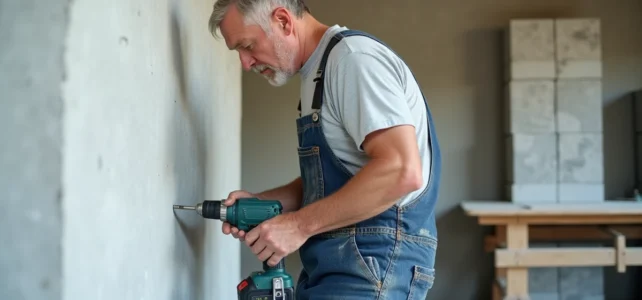
Cellular concrete (often marketed under the names Siporex or Ytong) is a building material valued for its thermal insulation qualities and lightness. Its cellular structure, which gives it these properties, also makes it particularly fragile when faced with conventional drilling tools. A poor setting or an unsuitable drill bit is enough to ovalize the hole, crumble the edges, or deeply crack the tile.
Why percussion destroys cellular concrete
The most common misconception is to treat cellular concrete like regular concrete. Reinforced or dense concrete indeed requires a hammer drill in percussion mode to penetrate the material. Cellular concrete, on the other hand, reacts in the opposite way: percussion causes ovalization and crumbling of the hole.
The Fischer Academy, in its guide to installing anchors, explicitly classifies cellular concrete among “soft masonry”. For these materials, the instruction is clear: drilling in rotation only, without percussion. The reason lies in the material’s density, which is much lower than that of solid concrete. Repeated impacts do not meet the necessary resistance to properly fragment the material; they crush it.
On a thin tile, the risk increases further. Vibrations can propagate to the opposite face of the block and cause a blowout, even if the drilling seems clean on the visible side. Mastering the techniques for drilling cellular concrete starts with this fundamental adjustment of the drill.
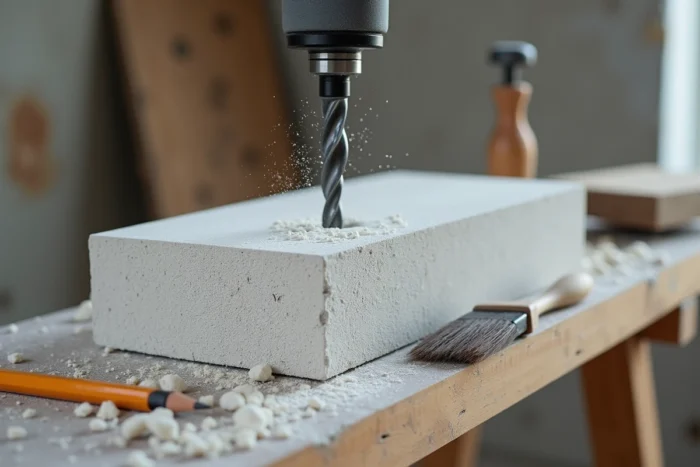
Drill bits for cellular concrete: tungsten carbide or wood bit
The choice of drill bit depends on the target diameter and the type of anchor to be installed. Two options work well on this material.
Standard concrete drill bit in rotation only
A tungsten carbide tipped drill bit is perfectly suitable, provided that you systematically disable the percussion mode. The carbide tip drills through cellular concrete without excessive effort. The mistake would be to force the rotation speed: a moderate speed allows the flutes to evacuate the dust without overheating the material.
Spiral wood bit
For small diameter holes (light fixtures, cable passage), a standard wood bit cleanly penetrates cellular concrete. Its centering tip minimizes the risk of slipping at the start. However, beyond a certain diameter, the wood bit lacks rigidity and the hole loses precision.
The SDS-Plus bit has no relevance here. It is designed for hammer drills, thus for percussion, and its shank does not fit a standard drill-driver.
Drilling protocol: steps to avoid block blowout
Beyond the right tool, it is the method that makes the difference between a clean hole and a cracked tile. Manufacturers of specific anchors for cellular concrete (such as Fischer GB or equivalents) condition their allowable loads to a precise protocol.
- Mark and point the location of the hole with a nail or light punch, without hitting hard, just enough to create a centering guide that prevents the drill bit from slipping on the surface.
- Set the drill to rotation only and moderate speed, then drill while allowing the bit to progress at its own pace, without excessive pressure. Dust should regularly exit through the flutes.
- Respect the minimum depth indicated by the anchor manufacturer. A hole that is too short prevents the complete deployment of the fastening mechanism and reduces the allowable load.
- Clean the hole after drilling, preferably with a blow gun or vacuum. A hole that is not dusted compromises the anchoring of the anchor: fine cellular concrete residues form a layer between the anchor and the wall of the hole.
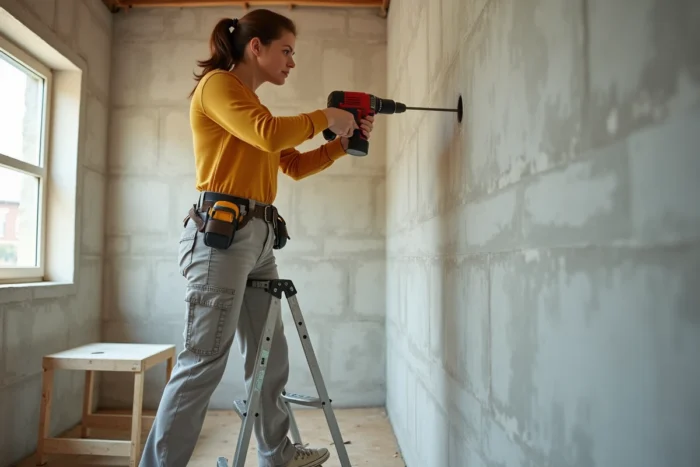
Anchors suitable for cellular concrete: drilling alone is not enough
Drilling cleanly guarantees nothing if the anchor is not designed for this material. Universal nylon anchors, designed for solid concrete or brick, provide only mediocre anchoring in a cellular structure. They expand in the air cavities instead of gripping the material.
Specific anchors for cellular concrete work differently. Some screw directly into the material (spiral anchors), while others expand laterally into the mass of the block thanks to wings. The allowable load depends on the diameter of the drilling and the installation protocol, not just on the model of the anchor.
For heavy loads (radiators, wall-mounted furniture), chemical fastening (bonding) is the most reliable alternative. The principle: inject a resin into the dusted hole, then insert a threaded rod. The resin penetrates the cells and creates an anchoring that is far superior to that of a mechanical anchor. The drilling must then be slightly oversized to leave sufficient annular space for the resin.
Tile thickness and material limits
A block of cellular concrete used in an interior partition often has a reduced thickness. Drilling in the center of the thickness remains the basic rule, but on a thin tile, the margin for error decreases significantly.
Mounting a heavy object on a thin cellular concrete partition poses a structural problem that drilling, no matter how careful, does not solve. The material has a limited pull-out resistance due to its density. Field reports vary on this point: some professionals accept significant loads with an appropriate chemical bonding, while others recommend reinforcement with a wooden beam or distribution plate when the support is too thin.
Before drilling, checking the actual thickness of the block and comparing it to the tables of the anchor manufacturer remains the only reliable way to anticipate the holding capacity of the fastening. A perfect hole in a material too thin for the intended load will not hold, regardless of the care taken in drilling.