
The term “turnkey house” encompasses very different contractual realities depending on the builder, the type of contract signed, and the exact scope of the included services. We regularly observe discrepancies between the commercial promise and the actual content of the technical description, particularly regarding finishing items and connections to networks.
CCMI and turnkey house: what the contract really covers
The individual house construction contract (CCMI) remains the most protective legal framework for the project owner. It imposes an agreed price, a delivery timeline, a guarantee of delivery at the agreed price and timeline, and a damage insurance. Any “turnkey” offer that does not rely on a CCMI deserves careful reading of the clauses.
The difficulty arises from the descriptive notice attached to the contract. It defines what the builder delivers. A vague description regarding floor coverings, plumbing fixtures, or interior carpentry leaves the door open for entry-level services, with no recourse possible since the contract is respected.
We recommend comparing the descriptive notice item by item with a quote from an independent project manager to measure the discrepancies. Before signing, it remains useful to learn everything about monhabitoo.fr with Ma Déco Maison to confront the promises with concrete feedback from homeowners.
Items frequently excluded from the “turnkey” scope, even when the term is displayed:
- Final connections to networks (water, electricity, sanitation), often billed by the providers in addition to the contract
- Exterior development: fences, gates, driveway paving, terraces, plantings
- Soil study fees (geotechnical study G2, mandatory since the ELAN law) and foundation adaptations if the land has constraints
- The equipped kitchen, built-in wardrobes, and sometimes even bathroom tiles

RE2020 and its impact on the budget of a turnkey construction
Since the implementation of the RE2020 environmental regulation, the requirements for insulation, heating, and the carbon footprint of materials have significantly altered the technical content of turnkey offers. Fossil fuel heating systems are excluded, insulation thicknesses are increasing, and carpentry must achieve higher thermal performance than under RT2012.
For a new turnkey house compliant with RE2020, the price ranges per square meter are between 1,300 and 1,700 euros according to recent sources, including structural work, finishing work, and connections. This price level represents a notable increase compared to constructions delivered under the previous thermal regulation.
Wood framing stands out in terms of the carbon aspect of RE2020, as wood stores CO2 instead of emitting it during its production. The additional cost of a turnkey wood frame remains real, mainly related to the price of panels and specialized labor.
Builders who offer wood in a turnkey package generally include the thermal study and air tightness test in their price, which is not always the case in traditional masonry.
Real customization versus fixed catalog
The promise of a “custom-made” house often accompanies the turnkey offer. In practice, customization frequently limits itself to choosing from predefined options: facade colors, types of tiles within a limited range, positioning of electrical outlets.
A builder working from a catalog optimizes costs by standardizing plans, supplies, and construction methods. This industrial logic allows for competitive pricing, but it mechanically reduces architectural leeway. Modifying a roof slope, shifting a facade opening, or integrating a material outside the range generates amendments whose costs bear no relation to the catalog price.
For a truly custom project, engaging an architect or a project manager with selected artisans offers more latitude. The overall price will often be higher, but each item is negotiated individually. The choice between turnkey and project management depends on the desired degree of control, not on an intrinsic superiority of one model over the other.
Points of caution regarding plans and land
Adapting the plan to the land is a frequent blind spot. A house model designed for flat land will require special foundations, a raised crawl space, or retaining walls if the plot has a slope. These adaptations can represent a significant part of the total budget.
The G2 soil study, made mandatory in areas exposed to shrink-swell clay, must be conducted before signing the CCMI. If the builder proposes to carry it out afterward, it is a warning sign: the results of this study condition the sizing of the foundations and thus the actual price of the project.
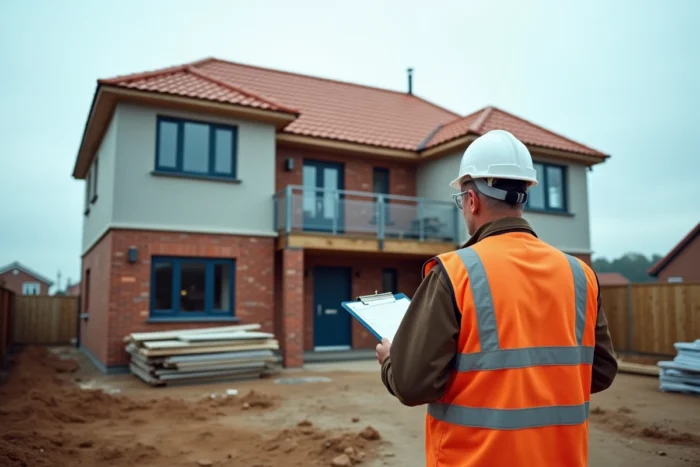
Site reception: technical traps to anticipate
The reception is the legal act by which the project owner accepts the work. It marks the starting point for guarantees (perfect completion, biennial, ten-year). Signing the reception report without reservations closes most recourse on apparent defects.
We systematically recommend being accompanied by an independent building expert on the day of reception. Their intervention costs a few hundred euros and helps identify non-conformities that an untrained eye might not detect: plumb defects, workmanship issues on carpentry joints, absence of slope on exterior thresholds, ventilation not compliant with regulatory flow rates.
Reservations must be formulated in writing, precisely, on the report. The builder then has a period to address each reservation. In case of refusal or silence, recourse to the judicial court remains possible within the framework of the perfect completion guarantee, which runs for one year after reception.
The turnkey house simplifies the construction process as long as one understands what the contract truly includes. The comfort of a single point of contact does not exempt one from a technical reading of the description, a budget forecast including excluded items, and a reception conducted with rigor.